Discipline Rules & Safety
Page Under Construction - Details for some disciplines are still being added.
Detailed rules and information for each clay shooting discipline will be available here. For official and comprehensive rules, please refer to the websites of governing bodies like the CPSA or FITASC.
Important Reminders
The rule summaries provided here offer a general understanding of various clay shooting disciplines. However, it is crucial to always:
- Verify with Official Sources: For comprehensive and up-to-date official rules, always refer to the websites of governing bodies like the CPSA, FITASC, ISSF, ATA, or your national/local association.
- Check Local Range Rules: Every shooting ground will have its own specific rules for gun handling, safety procedures, and range conduct. Familiarize yourself with these before shooting.
- Practice Safe Firearm Handling: Always treat every firearm as if it were loaded. Keep the muzzle pointed in a safe direction, keep your finger off the trigger until ready to shoot, and ensure your firearm is unloaded and actions are open when not actively shooting or as required by range rules.
- Secure Firearms & Ammunition: Ensure all firearms and ammunition are stored securely and legally, both at home and during transit.
- Vehicle Security: If transporting firearms, always ensure your vehicle is securely locked when unattended. Do not leave firearms or ammunition visible.
Safety and responsibility are paramount in shooting sports.
DTL
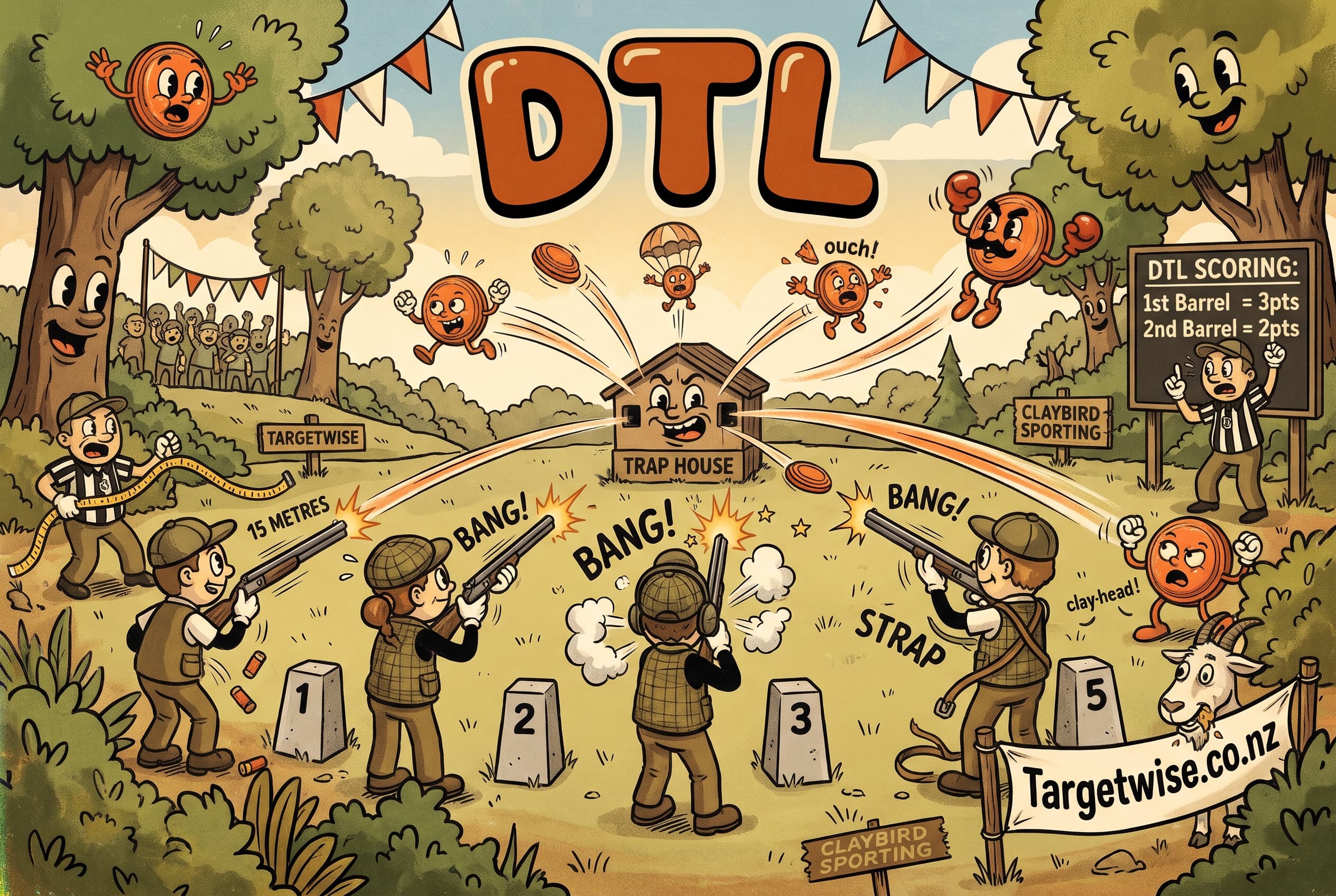
A trap shooting discipline where targets are thrown from a single trap house, oscillating horizontal...
Objective: Break clay targets launched from a single oscillating trap.
Layout: Five shooting stands arranged in a crescent shape 16 yards (or meters, depending on local rules) behind the traphouse.
Shooting Sequence: Shooters take 5 shots from each of the 5 stands, totaling 25 targets per round. A full competition is typically 4 rounds (100 targets).
Target Flight: Targets are thrown to varying heights and angles, generally within a 44-degree horizontal arc (22 degrees left and right of center). Maximum height is typically 3.5 meters and minimum 1.5 meters at 10 meters from the trap. Targets should travel between 48 and 52 yards.
Shots Allowed: Two shots are allowed per target.
Gun Position: Gun can be pre-mounted (in the shoulder) when calling for the target.
Scoring:
- First barrel hit: 3 points.
- Second barrel hit: 2 points.
- Miss with both barrels: 0 points.
Maximum score per round of 25 targets is 75 points. Maximum for 100 targets is 300 points.
Safety: Standard firearm safety rules apply. Guns must be open and empty when moving between stands. Action open, safety catch on until ready to shoot.
Sporting
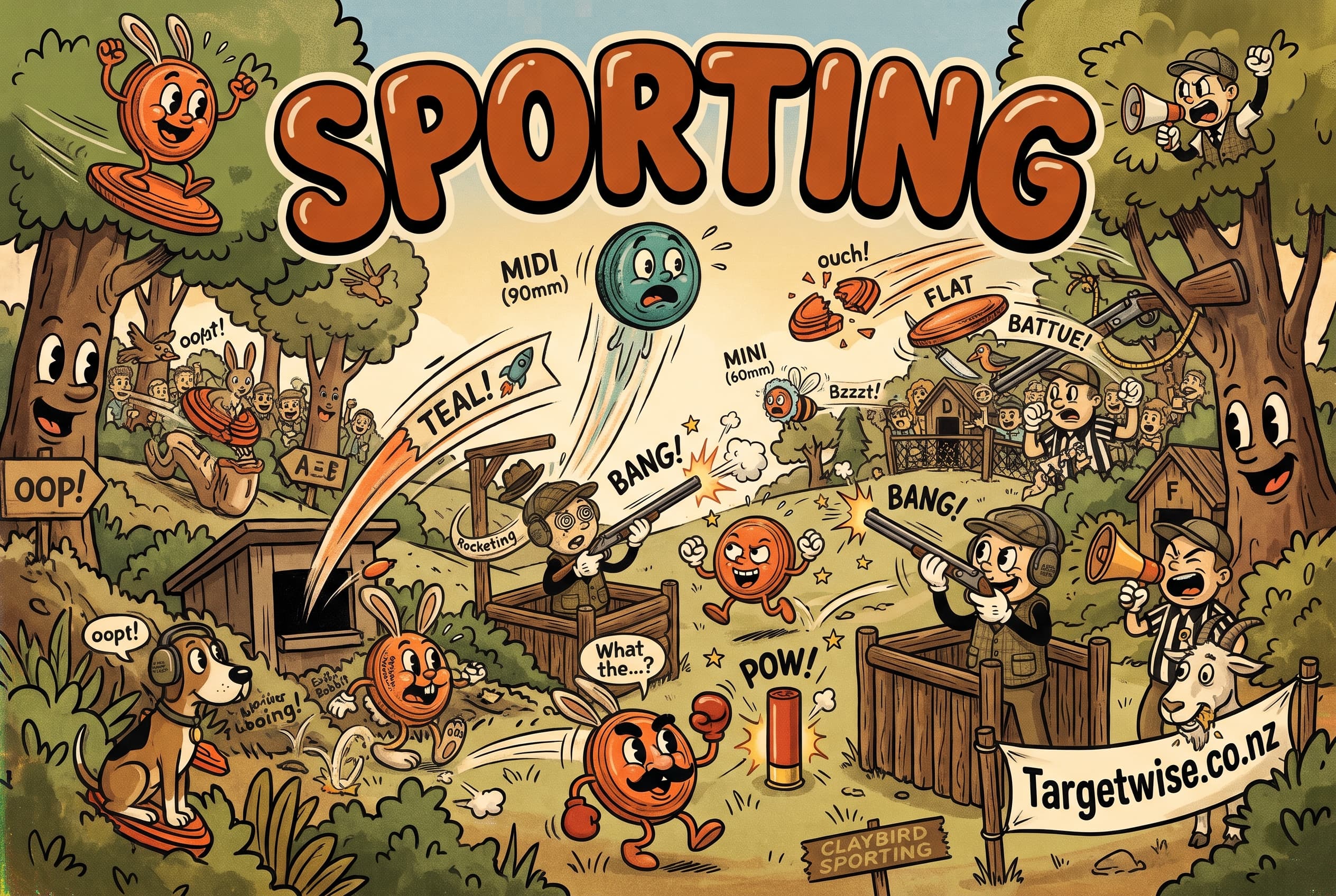
Simulates live quarry shooting. Targets are thrown in a variety of trajectories, angles, speeds, ele...
Objective: To hit a variety of targets that simulate live game shooting scenarios.
Layout: A course consists of multiple stands (typically 10-15), each presenting unique target combinations from different traps.
Target Presentation: Targets can be singles or pairs (simultaneous, on-report, or following). They vary in speed, angle, distance, and type (standard, midi, mini, battue, rabbit, teal, etc.).
Shooting Sequence: Shooters attempt a set number of targets at each stand as per the menu card for that stand.
Shots Allowed: Generally, two shots are allowed for a single target. For pairs, one shot is allowed per target unless specified otherwise (e.g., "full use of gun" on a specific pair).
Gun Position: Typically, the gun can be pre-mounted (in the shoulder) or gun-down, depending on the shooter's preference or specific competition rules (e.g., FITASC Sporting requires gun-down).
Scoring: One point is awarded for each target broken and visibly seen to be broken by the referee.
Safety: Paramount. Guns must be carried open and empty between stands. Only load when on the stand and it is your turn to shoot. Always observe muzzle awareness. Eye and ear protection is mandatory.
Skeet
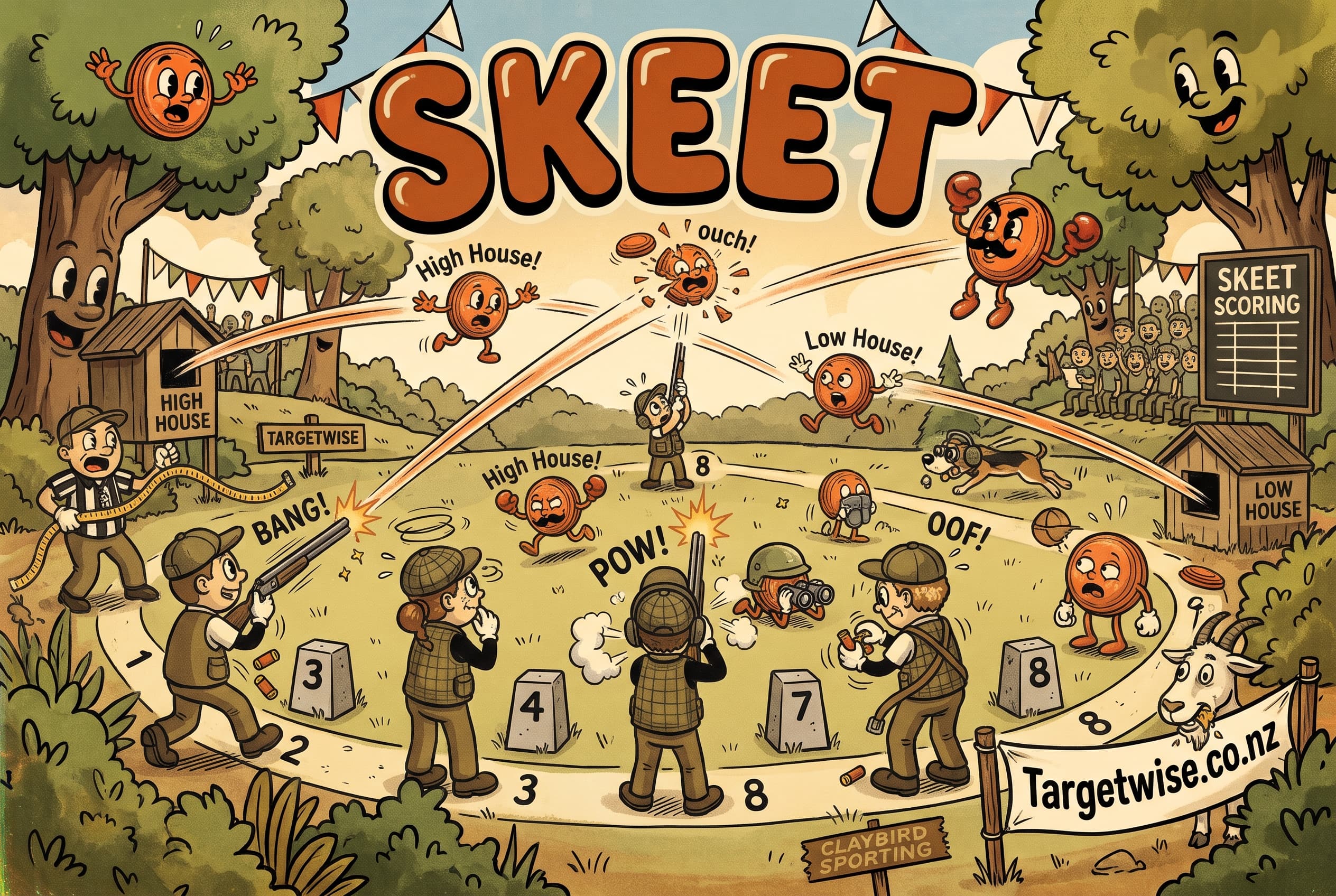
Targets are thrown from two trap houses (high and low) in a semi-circular arrangement of 7 stations,...
Objective: Break targets launched from a High House (left) and a Low House (right).
Layout: Seven shooting stations arranged in a semi-circle between the two trap houses, plus an eighth station directly between stations 1 and 7.
Target Flight: Targets fly on fixed paths. High House targets emerge from ~10ft high, travel towards station 7. Low House targets emerge from ~3.5ft high, travel towards station 1. Both cross at the "crossing point" over station 8.
Shooting Sequence: A round is 25 targets. Shooters progress through stations 1-8 in order.
- Stations 1 & 2: Single High, Single Low, then a simultaneous pair (High then Low).
- Stations 3, 4, & 5: Single High, Single Low.
- Stations 6 & 7: Single High, Single Low, then a simultaneous pair (Low then High).
- Station 8: Single High, then Single Low.
Option Target: If a shooter misses their first target in the round, they must repeat that specific target immediately (this is the "option" shot). If all 24 initial targets are hit, the 25th target is a Low House single from station 8.
Shots Allowed: One shot per target.
Gun Position: Shooters typically start with the gun "gun down" (not pre-mounted), mounting the gun as the target appears. However, CPSA rules allow pre-mounting for English Skeet.
Scoring: One point for each target broken.
Safety: Standard firearm safety rules apply. Guns must be open and empty when moving between stations. Eye and ear protection mandatory.
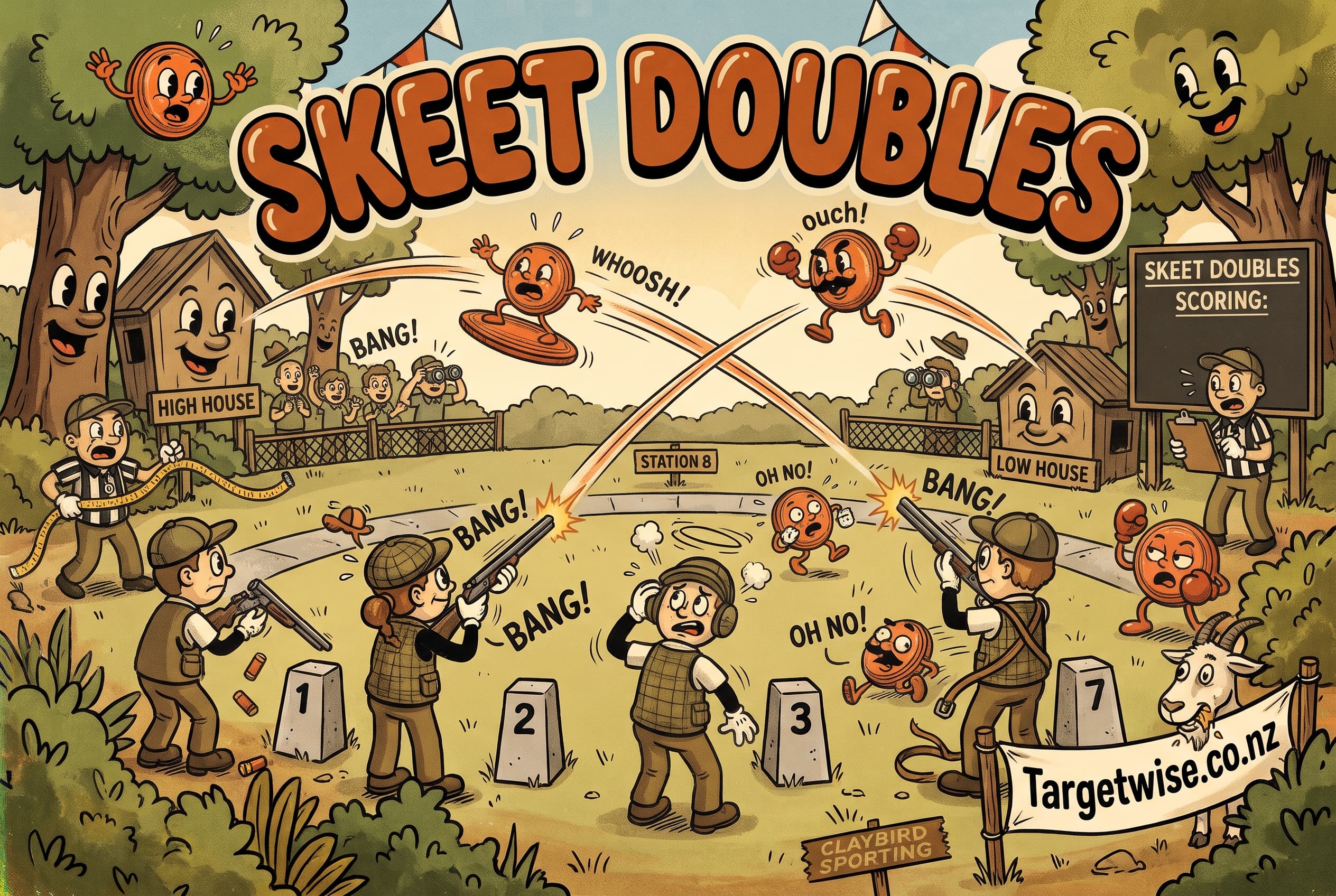
Skeet Doubles
A variation of Skeet where all targets are thrown as simultaneous pairs....
Objective: Break simultaneous pairs thrown from the High and Low houses.
Layout: Follows the standard 8-station Skeet layout.
Shooting Sequence: A round of 50 targets (25 pairs). Shooters typically shoot pairs at stations 1-7, with variations in sequence. A common layout is pairs at 1, 2, 3, 4, 4(reversed), 5, 6, 6(reversed), 7, 1, 2, 3.
Shots Allowed: One shot per target. The first shot must be taken at the first target of the pair (as determined by the station rules), and the second shot at the second target.
Gun Position: Same as the corresponding primary Skeet discipline (e.g., English or Olympic).
Scoring: One point for each target hit.
Safety: Standard Skeet safety rules apply.
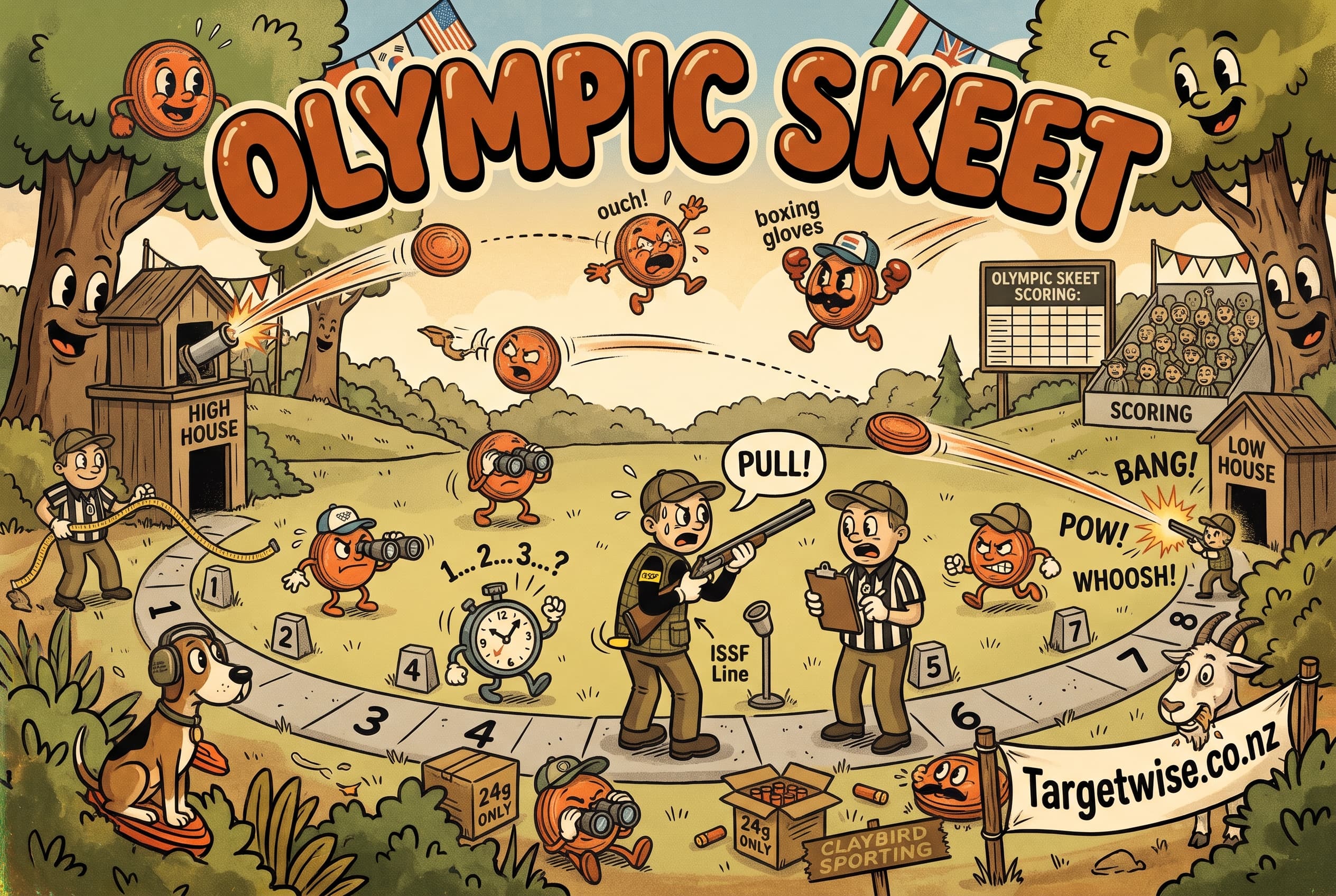
Olympic Skeet
ISSF discipline with faster targets, a random timer, and a mandatory gun-down start position....
Objective: Break targets from a High and Low house with strict rules on gun position and timing.
Layout: Same 8-station semi-circular layout as English Skeet.
Target Flight: Targets are faster (approx. 65-70 mph) than in English Skeet.
Gun Position: Gun must be held in a "gun down" ready position. The heel of the stock must be touching the body at a marked line on the shooter's vest (typically at hip level) until the target appears.
Target Release: After the shooter calls for the target, there is a random electronic timer with a delay of 0 to 3 seconds before the target is released.
Shooting Sequence: The sequence of singles and pairs is different and more complex than English Skeet, designed to be more challenging. A round is 25 targets.
Shots Allowed: One shot per target.
Scoring: One point is awarded for each target broken.
Safety: Strict adherence to ISSF safety regulations.
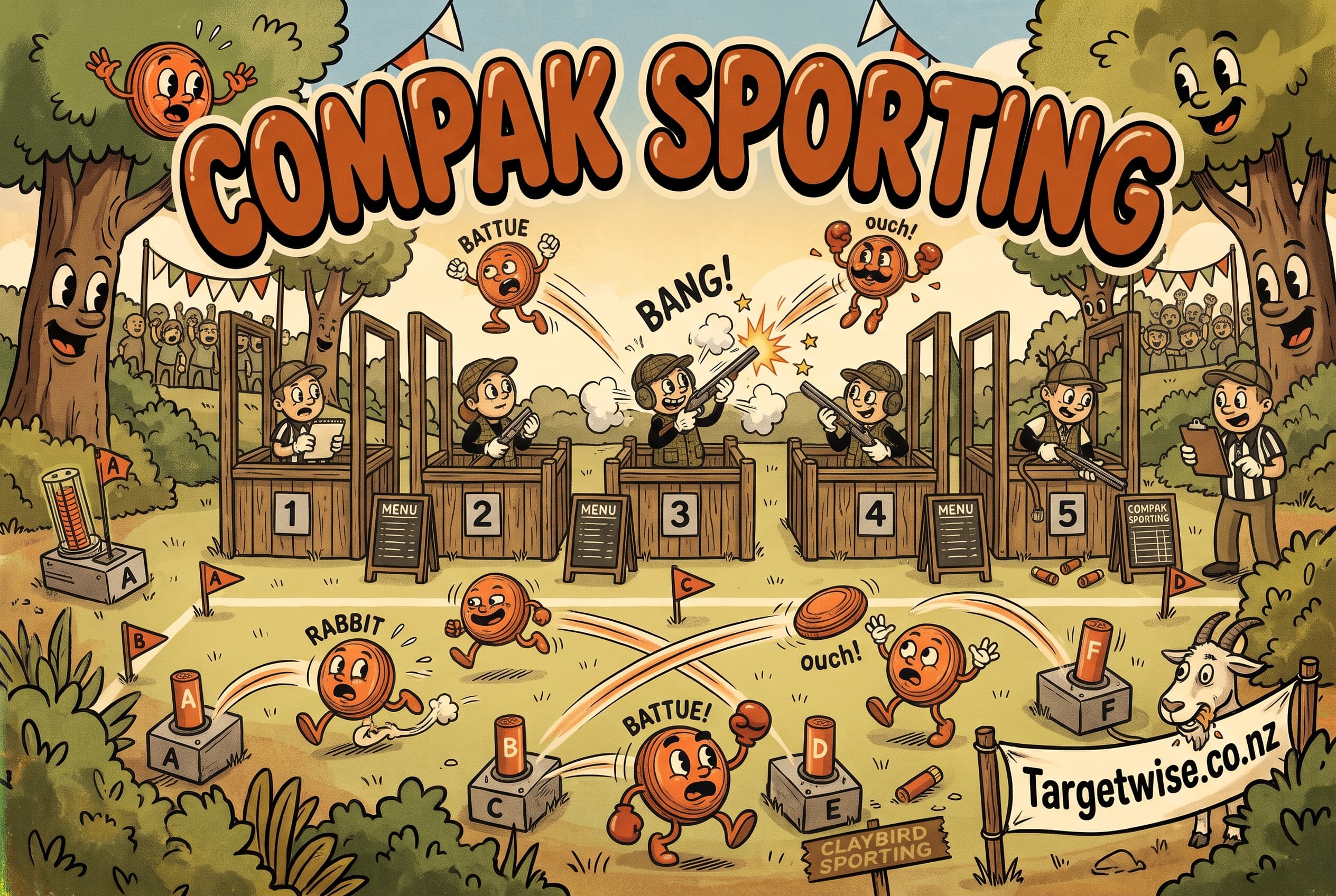
Compak Sporting
A condensed version of sporting clays, shot from 5 stations within a marked area. Uses a variety of ...
Objective: Provide a Sporting Clays experience on a more compact ground.
Layout: Typically uses 5 shooting stations (cages or hoops) arranged in a line or arc. The layout must fit within a 40m x 25m rectangle.
Traps: A minimum of 6 traps are used, throwing a variety of targets (standard, midi, mini, battue, rabbit, teal, etc.). Trajectories are varied, simulating game.
Shooting Sequence: A round usually consists of 25 targets. Shooters rotate through the 5 stations. At each station, a menu indicates the sequence of targets (e.g., a single, simultaneous pair, on-report pair). Shooters typically shoot 5 targets per station.
Target Order: For pairs, the order (e.g., target A then B, or B then A) is often specified.
Shots Allowed: Two shots are allowed for single targets. For pairs, one shot per target is usually allowed unless otherwise specified (e.g., "full use of gun" means two shots can be used on either target if the first is missed).
Gun Position: Gun must be held in a "ready position" (gun down), not pre-mounted, until the target is visible or appears. The stock must be below a line marked on the shooter's vest (typically 25cm below the shoulder).
Scoring: One point for each target hit.
Safety: Strict safety rules apply. Guns must be open and empty when not on the shooting station. Eye and ear protection is mandatory.
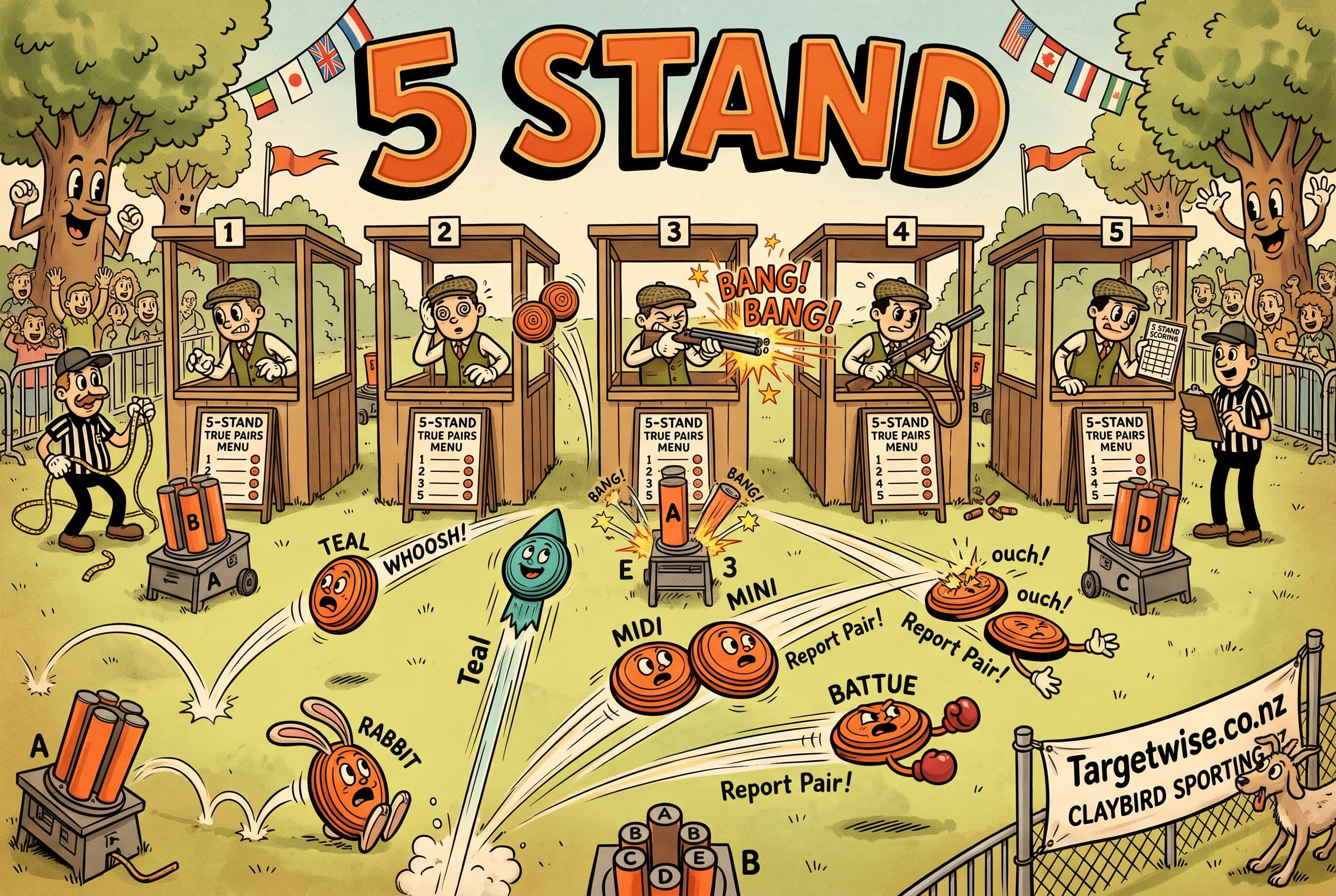
5-Stand
A condensed form of sporting clays with 5 stations and various target presentations from multiple tr...
Objective: To shoot a variety of targets from five different stands in a compact layout.
Layout: Five shooting stands (cages) are arranged in a line. A number of traps (typically 6 to 8) are placed around the layout to throw a variety of target presentations.
Shooting Sequence: A round consists of 25 targets. Shooters take 5 targets at each of the 5 stands. A menu at each stand explains the sequence (e.g., a single target, a report pair, and a true/simultaneous pair).
Target Presentation: Each stand will have a different combination of targets from the available traps, creating a unique challenge at each position.
Shots Allowed: Generally, two shots are allowed for a single target. For pairs, one shot is allowed per target.
Gun Position: Typically, shooters can start with a pre-mounted gun, but local club rules may vary.
Scoring: One point is awarded for each target broken.
Safety: Standard firearm safety rules apply. Guns must be open and empty when moving between stations.
Olympic Trap
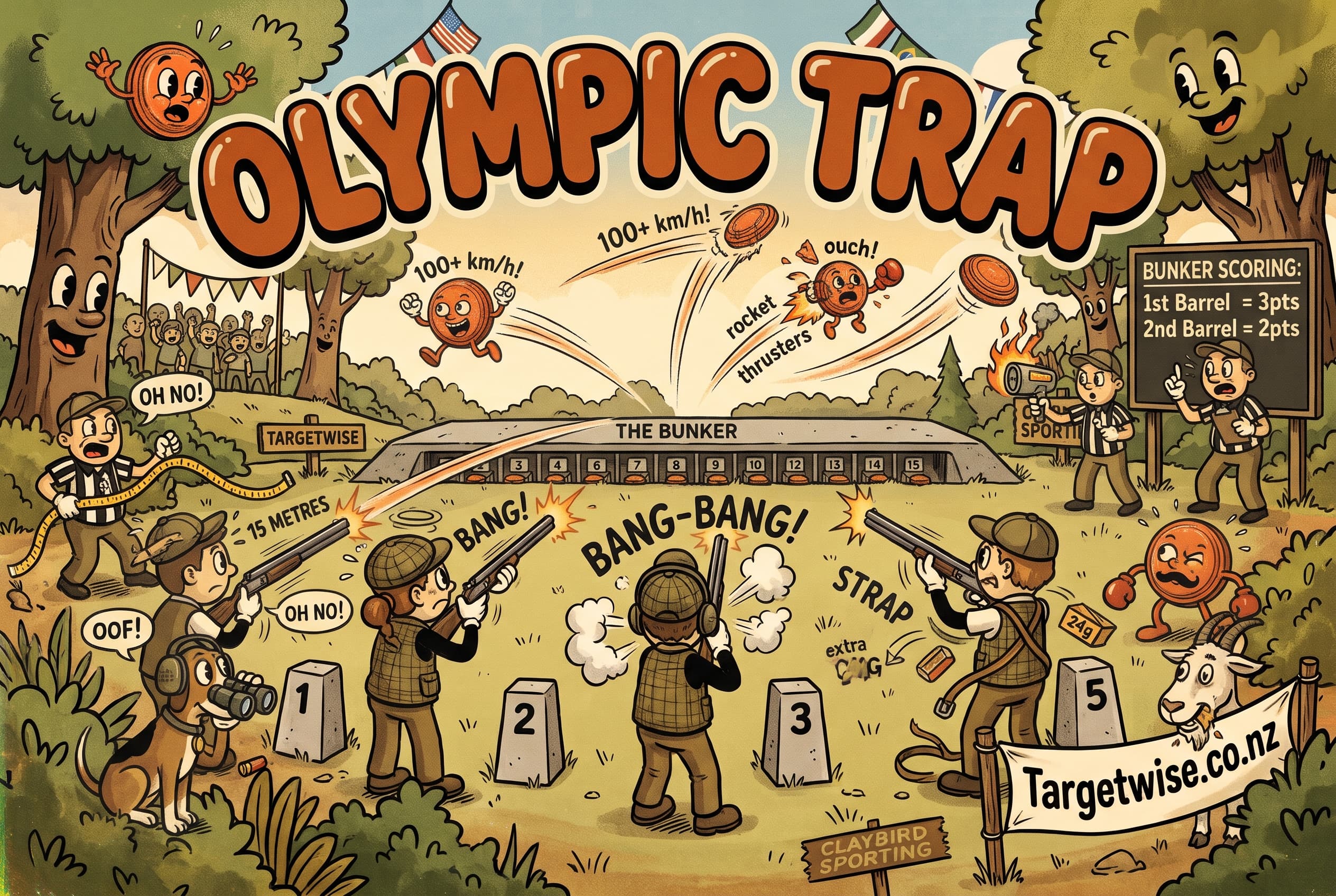
Targets are thrown from 15 traps in a trench in front of the shooters. Targets are faster and angles...
Objective: Break clay targets launched from a bunker containing 15 traps.
Layout: Five shooting stations arranged in a line, 15 meters behind the traphouses.
Target Release: Traps release targets according to fixed (but unknown to the shooter) schemes/programs. Each station has 3 traps in front of it (left, center, right).
Target Flight: Targets are very fast (up to 100-120 km/h), with wide horizontal angles (up to 45 degrees left or right) and varying heights.
Shooting Sequence: Shooters take turns shooting at single targets. A round consists of 25 targets. Competitions typically involve 5 rounds (125 targets) for qualification, followed by finals for the top shooters.
Shots Allowed: Two shots are allowed per target in qualification rounds. In finals, rules may vary (often single shot).
Gun Position: Gun can be pre-mounted.
Scoring: One point is awarded for each target hit within the shooting zone.
Safety: Strict adherence to ISSF safety regulations. Actions open when not shooting, muzzle control critical.
ABT (Trench)
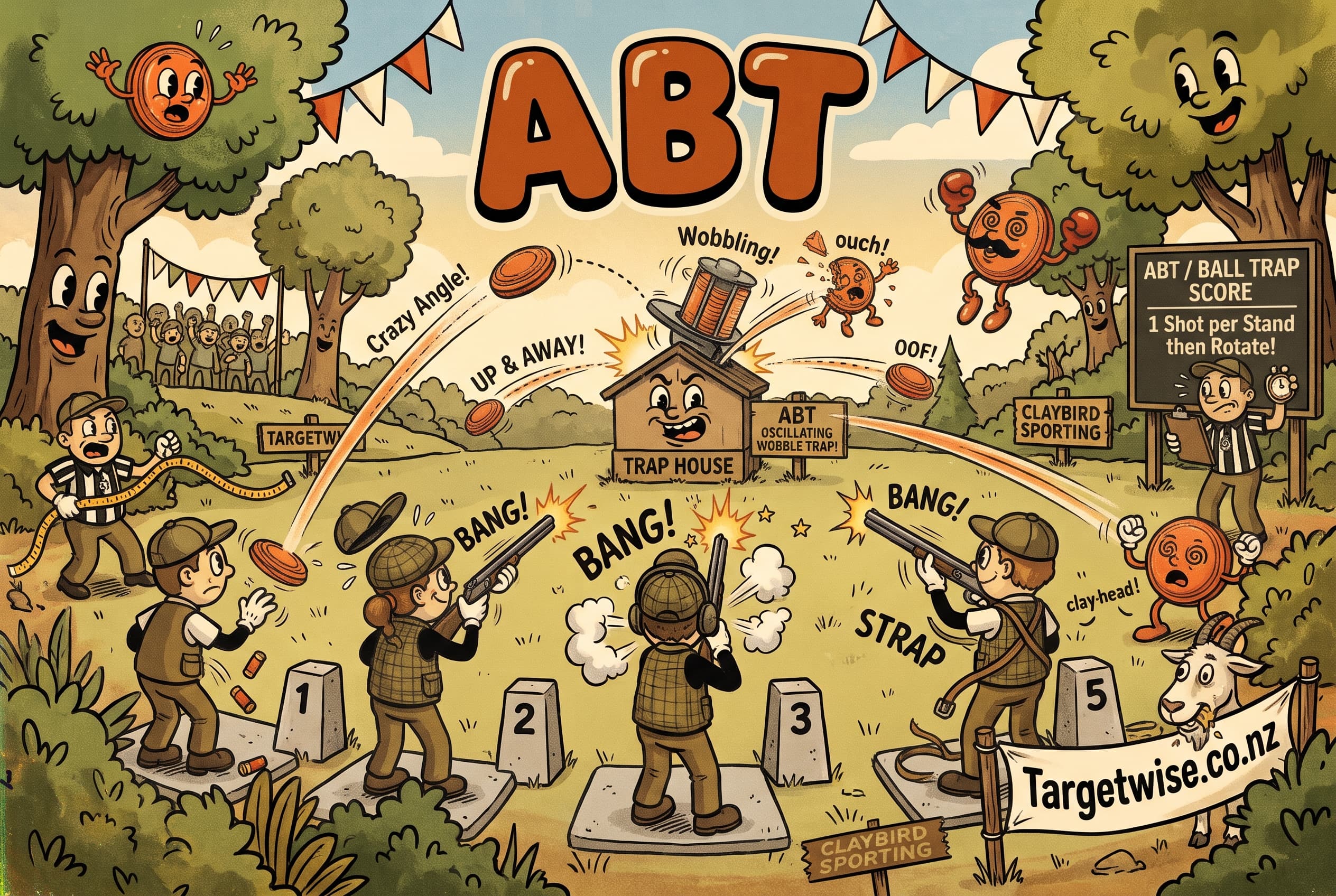
Also known as Wobble Trap. A fast-paced trench discipline where targets are thrown from a single tra...
Objective: Break single targets from a single trap that moves randomly.
Layout: Five stations in a line, 15 meters behind a trench or bunker.
Target Flight: A single trap oscillates both horizontally (side-to-side) and vertically (up-and-down), creating unpredictable target paths. This randomness is the key feature.
Shooting Sequence: A round is 25 targets. Shooters take 5 shots from each station, rotating after each shot.
Shots Allowed: Two shots are allowed per target.
Gun Position: The gun can be pre-mounted.
Scoring: Usually scored as 1 point per hit, regardless of whether it was the first or second barrel.
Safety: Standard trap safety rules apply. Muzzle control is paramount.
American Trap
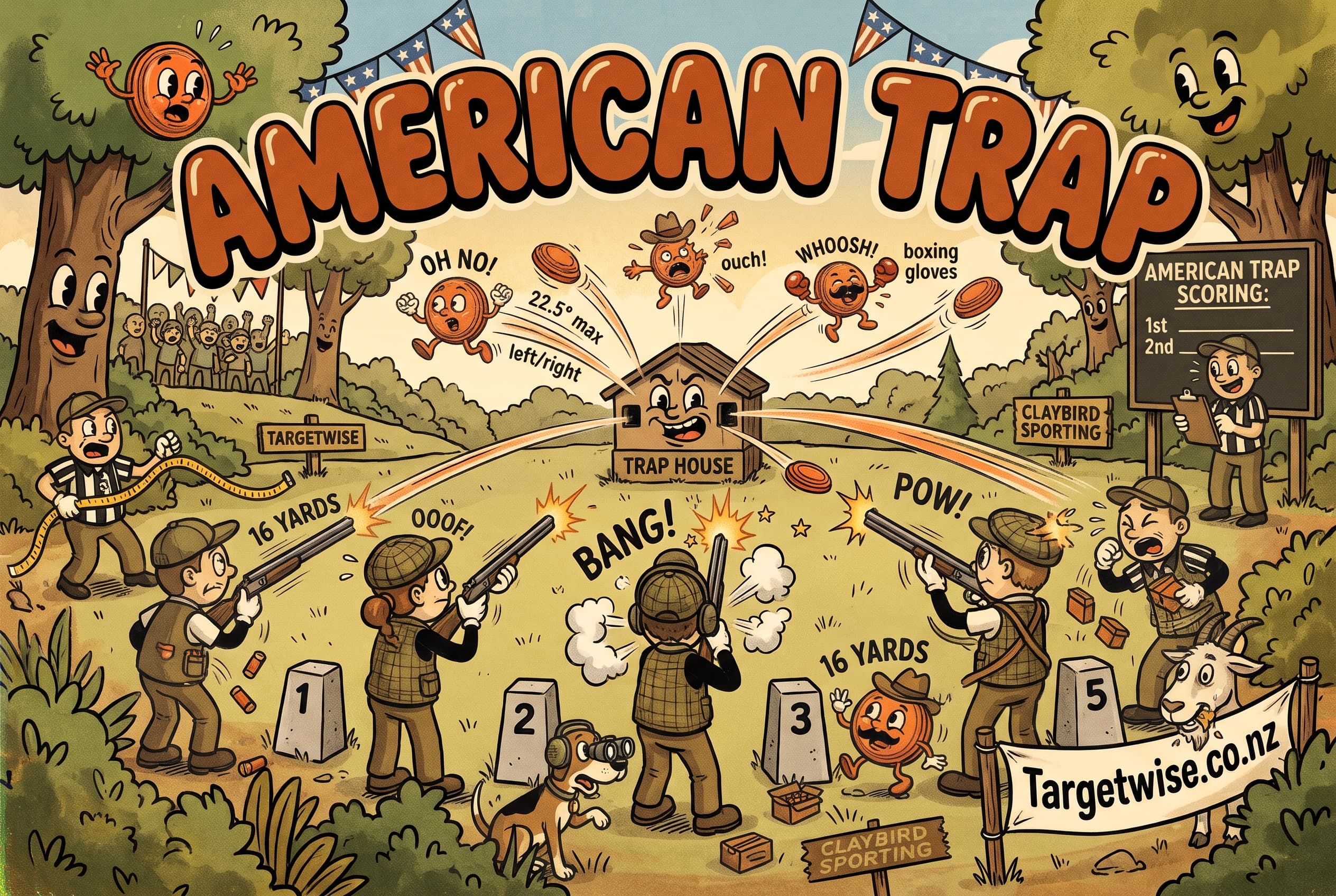
A popular American discipline with one trap throwing targets at narrower angles than Olympic Trap. I...
Objective: Break single clay targets launched from a single traphouse.
Layout: Five shooting stands in an arc, starting at 16 yards behind the traphouse for singles events.
Shooting Sequence: A round consists of 25 targets, with 5 shots taken from each of the 5 stations.
Target Flight: The trap oscillates in a narrower arc than DTL or Olympic Trap (not exceeding 22 degrees left or right). Target height is consistent.
Shots Allowed: One shot is allowed per target.
Gun Position: Gun can be pre-mounted.
Scoring: One point is awarded for each target hit.
Handicap System: In handicap events, shooters stand at various distances from the trap (up to 27 yards) based on their proven ability.
Double Trap
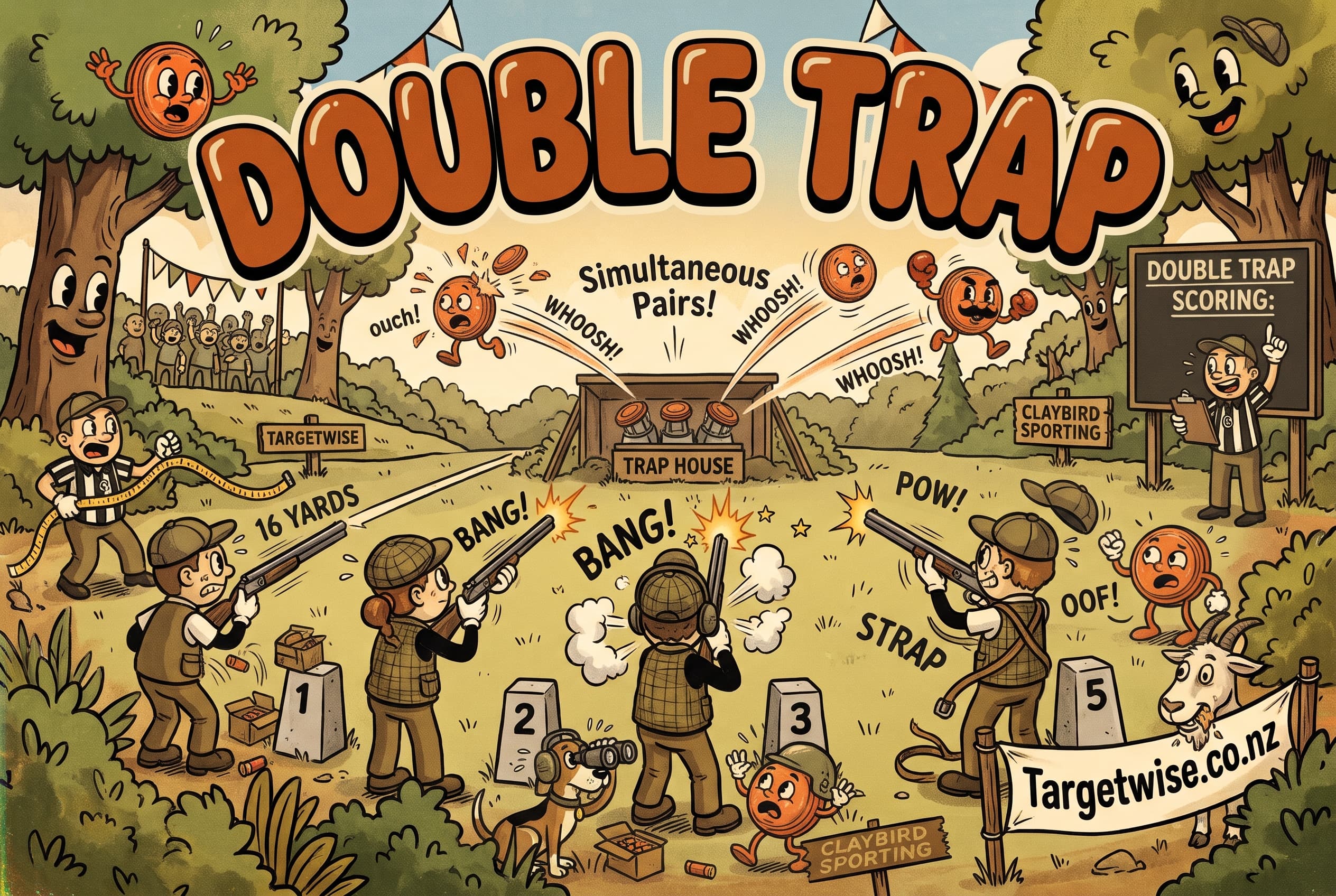
A challenging trap discipline where two targets are released simultaneously from a single bunker....
Objective: To break a pair of targets launched simultaneously from a central bunker trap.
Layout: Five shooting stations in a line, 15 meters behind the bunker, similar to Olympic Trap.
Target Presentation: Two targets are launched at the same time from trap machines in a fixed bunker. The targets have set angles and heights (e.g., Scheme A: 0 degrees, Scheme B: 5 degrees left/right, Scheme C: 10 degrees left/right).
Shooting Sequence: A round typically consists of 25 or 30 pairs (50 or 60 targets).
Shots Allowed: One shot per target.
Gun Position: Gun can be pre-mounted.
Scoring: One point for each target hit.
Safety: Strict adherence to ISSF safety regulations. Muzzle control is critical due to the wide arc of fire.
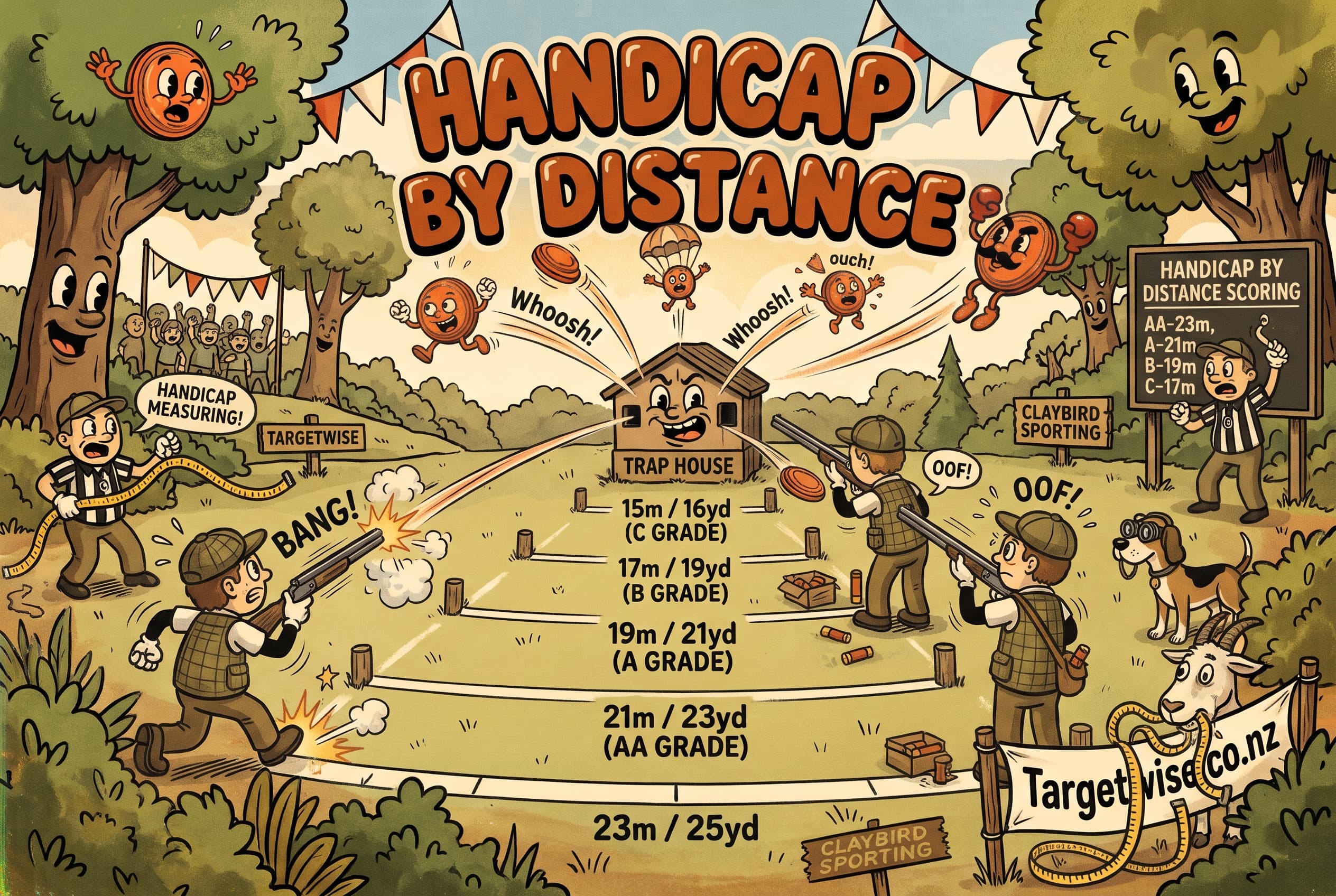
Handicap by Distance
A trap discipline where shooters are handicapped by shooting from different distances from the trap ...
Objective: Break single clay targets launched from a traphouse.
Layout: Similar to DTL or American Trap, with 5 shooting stations.
Handicap System: Shooters are assigned a handicap yardage (or meterage) based on their known ability or classification. This distance is measured from the traphouse. Common handicap distances range from 16 yards (for beginners) up to 27 yards (for top shooters).
Shooting Sequence: Shooters fire in squads, rotating through the 5 stations. Typically, 5 shots are taken at each station for a round of 25 targets.
Target Flight: Targets are thrown at various unknown angles (within a set arc) and at a consistent speed and height.
Shots Allowed: Usually one shot is allowed per target, though some local rules might permit two.
Gun Position: Typically, the gun can be pre-mounted.
Scoring: One point is awarded for each target hit.
Safety: Standard firearm safety rules apply. Guns must be open and empty when not actively shooting or moving between stations.
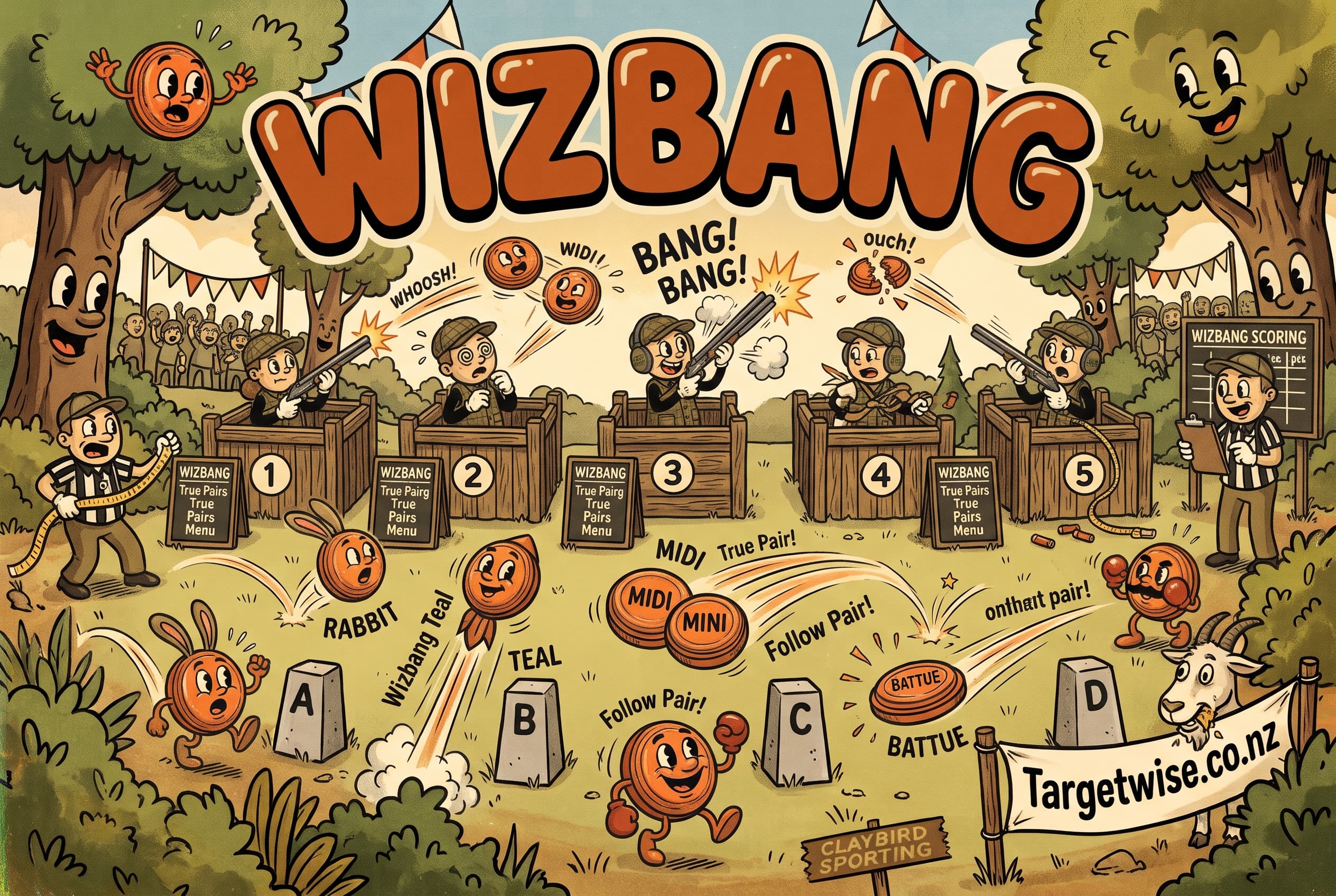
Wizbang
A fast-paced, unpredictable trap discipline where targets are thrown at random angles and speeds, of...
Objective: To hit a challenging and unpredictable sequence of targets for fun and practice.
Layout: Often uses 5 stands similar to DTL or Trap, but can be adapted. The key is the unpredictable nature of the traps.
Target Flight: This is the main feature. Targets can be standard clays, rabbits, battues, etc. They are thrown at varying speeds, angles, and heights, often with a 'mystery' element where the shooter doesn't know what will be thrown next.
Shots Allowed: Usually two shots per target, but rules can vary by club.
Gun Position: Typically gun-down to increase the challenge, but pre-mounting may be allowed in less formal settings.
Scoring: One point per target hit.
Safety: Standard firearm safety rules apply. Always be prepared for an unexpected target trajectory while maintaining muzzle discipline.
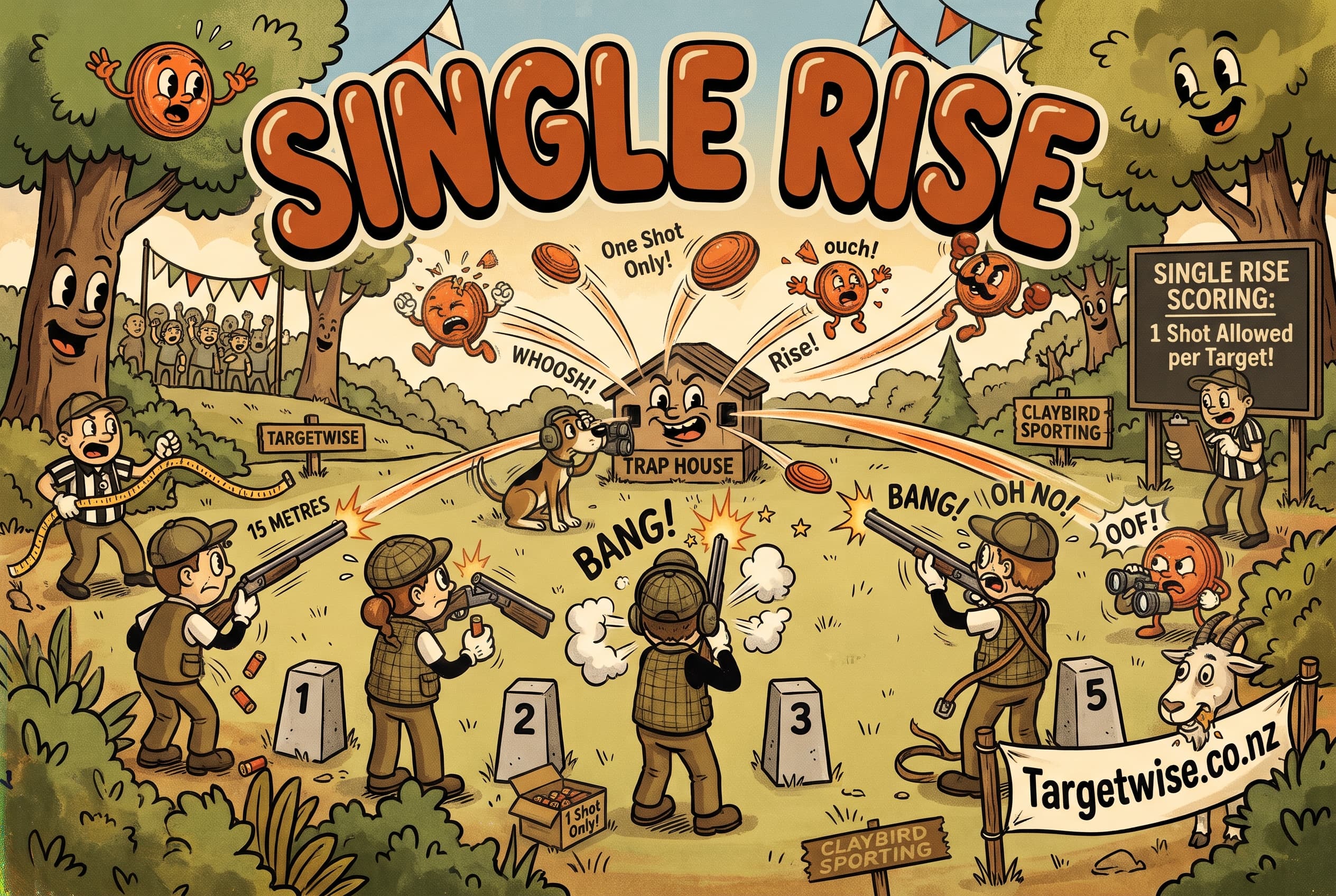
Single Rise
A trap discipline where single targets are thrown in a rising trajectory from a single trap house. S...
Objective: Break clay targets launched in a rising trajectory from a single trap house.
Layout: Five shooting stands arranged in a straight line, typically 16 yards behind the traphouse.
Shooting Sequence: Shooters take 5 shots from each of the 5 stands, totaling 25 targets per round. A full competition is typically 4 rounds (100 targets).
Target Flight: Single targets are thrown in a rising arc, consistently gaining height as they travel downrange. The trajectory is predictable and consistent, allowing shooters to establish a reliable shooting rhythm.
Shots Allowed: Two shots are allowed per target.
Gun Position: Gun can be pre-mounted (in the shoulder) when calling for the target.
Scoring: One point for each target hit.
Safety: Standard firearm safety rules apply. Guns must be open and empty when moving between stands.
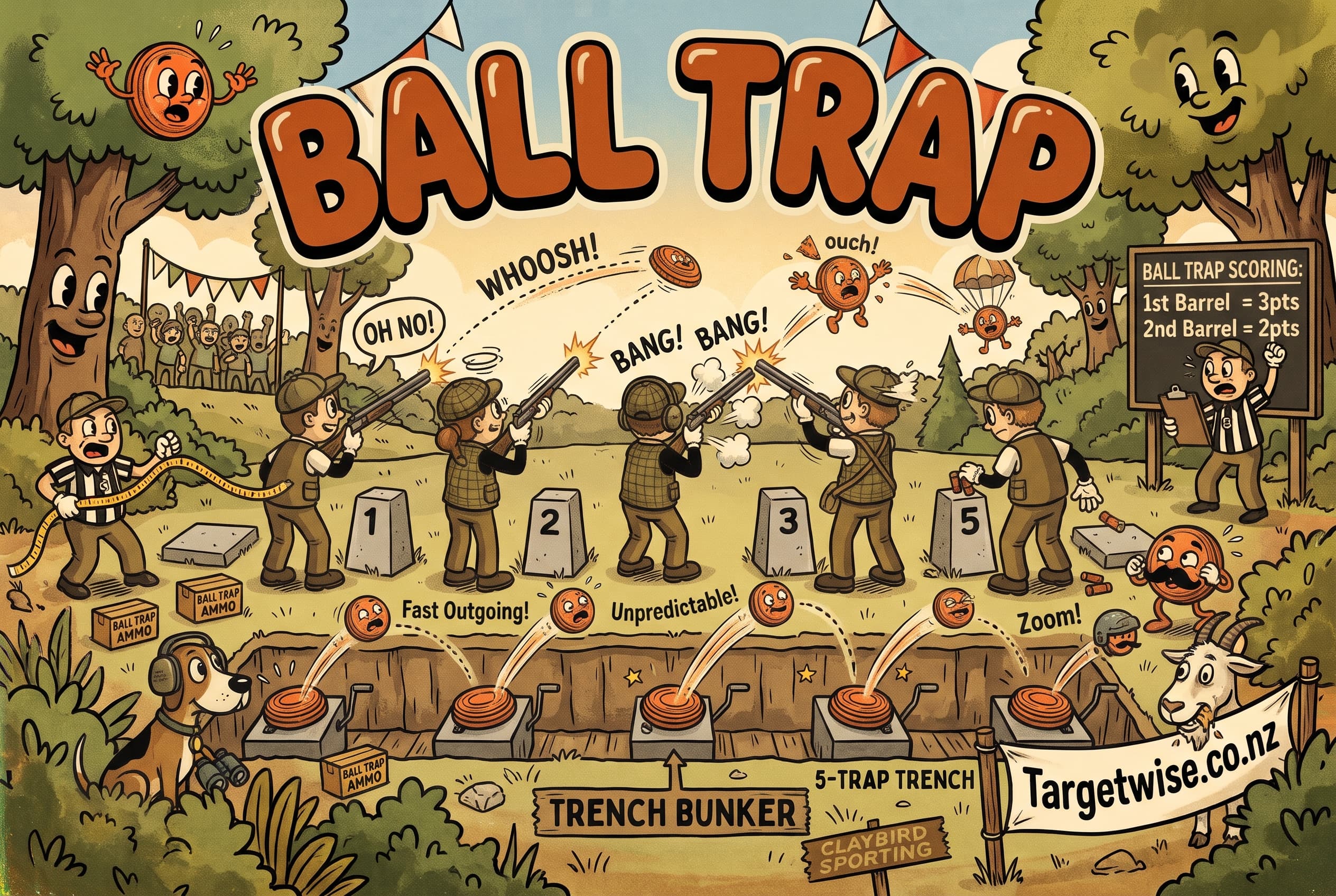
Ball Trap
A trap discipline where single targets are thrown from a ball trap machine in a driven or consistent...
Objective: Break clay targets launched from a ball trap machine.
Layout: Five shooting stands arranged in a line or arc, typically 16 yards behind the ball trap.
Shooting Sequence: Shooters take 5 shots from each of the 5 stands, totaling 25 targets per round. A full competition is typically 4 rounds (100 targets).
Target Flight: Targets are thrown in a consistent, driven trajectory from the ball trap mechanism. The flight path is regular and predictable, creating a steady, rhythm-based shooting experience.
Shots Allowed: Two shots are allowed per target.
Gun Position: Gun can be pre-mounted (in the shoulder) when calling for the target.
Scoring: One point for each target hit.
Safety: Standard firearm safety rules apply. Guns must be open and empty when moving between stands.